
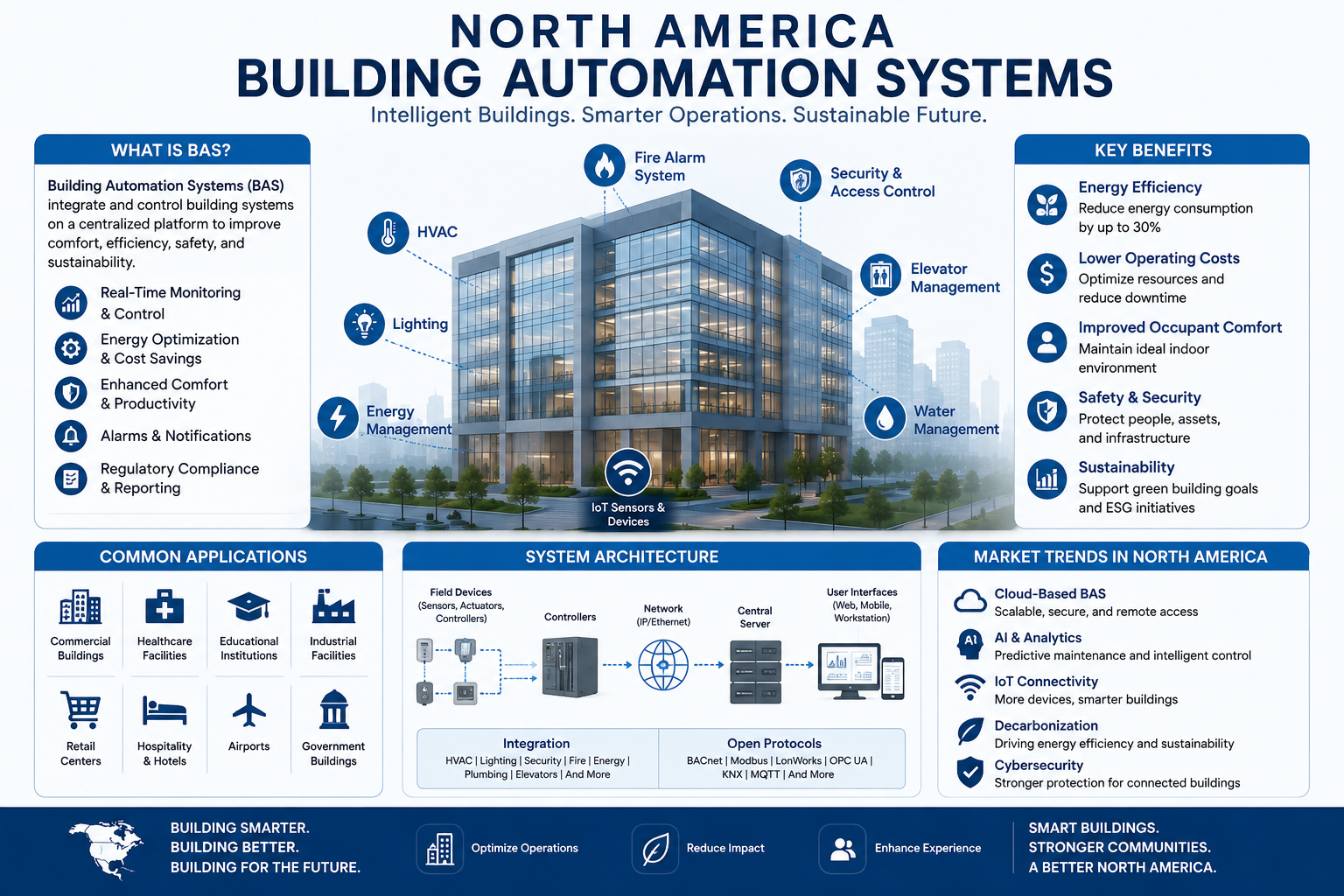
The North America Building Automation Systems (Bas) Market Trends indicate a clear path toward fully autonomous building operations. As we move further into the decade, the reliance on energy management systems is being augmented by artificial intelligence that can make decisions without human intervention, optimizing environments in real-time.
Market Overview and Introduction
The current trend is a move away from static, programmed responses toward dynamic, data-driven management. Modern BAS are no longer just about turning lights off at 6 PM; they are about understanding why the lights are on and how to provide the best environment for the people in the room. This shift is turning buildings into living, breathing entities.
Key Growth Drivers
One of the biggest trends is the "Wellness" movement. Following the global health crisis, there has been a surge in demand for commercial building automation that monitors air purification, humidity, and CO2 levels. Employee well-being is now seen as a major economic driver, leading to increased investment in systems that prioritize human health alongside energy efficiency.
Consumer Behavior and E-commerce Influence
Consumers are now accustomed to the seamless experience of smart home devices and expect the same from their workplaces. This "consumerization" of professional BAS has led to the development of intuitive mobile apps and dashboards. E-commerce has also enabled a trend of "micro-purchasing," where managers can buy individual software upgrades or specialized sensors to solve specific building issues as they arise.
Regional Insights and Preferences
In North America, there is a strong trend toward "grid-interactive" buildings. This is particularly prevalent in California and the Northeast, where the power grid is under frequent stress. Buildings are being designed to act as giant batteries, storing energy when it's cheap and using it—or even selling it back—when the grid is at peak capacity.
Technological Innovations and Emerging Trends
The use of Lidar and advanced occupancy sensors is a major trend. Unlike cameras, which raise privacy concerns, Lidar can track movement and density without identifying individuals. This data is invaluable for optimizing HVAC and lighting in large open-plan offices, ensuring that energy is never wasted on empty spaces.
Sustainability and Eco-friendly Practices
The trend toward "circular" building management is gaining steam. This involves using BAS to track the lifecycle of building components, ensuring that they are maintained properly and recycled at the end of their life. This holistic approach to sustainability is becoming a key differentiator for top-tier real estate developers.
Challenges, Competition, and Risks
The biggest challenge within these trends is the "legacy gap"—the difficulty of integrating brand-new AI software with 20-year-old mechanical hardware. Competition is also heating up as non-traditional players, like major tech firms, begin to offer their own building management data platforms, threatening the dominance of traditional industrial firms.
Future Outlook and Investment Opportunities
The integration of BAS with the "Metaverse" or digital twinning is a significant future trend. Being able to walk through a digital version of a building to troubleshoot a mechanical issue is no longer science fiction. This presents a massive opportunity for software developers and service providers who can bridge the gap between the physical and digital worlds.
➤➤Explore Market Research Future- Related Ongoing Coverage In Semiconductor Industry:
Hybrid Memory Cube And High-Bandwidth Memory Market
Smart Power Distribution System Market

 English
 French
 Spanish
 Portuguese
 Deutsch
 Turkish
 Dutch
Dutch
 Italiano
 Russian
 Romaian
 Portuguese (Brazil)
 Tiếng Việt